
Technologies are not neutral, we know. They're not the same, they're all different. It does not depend (only) on how we use them: they also have specific characteristics. Let's learn how to evaluate them according to their characteristics.
How to distinguish the many technological proffers that come to us every day? Better this messaging system or this one? This model IA or this one? This company or this one? What do experts say? Are there any alternatives?
We need an audit method, not just technical, but ethical. What systems are appropriate for us?
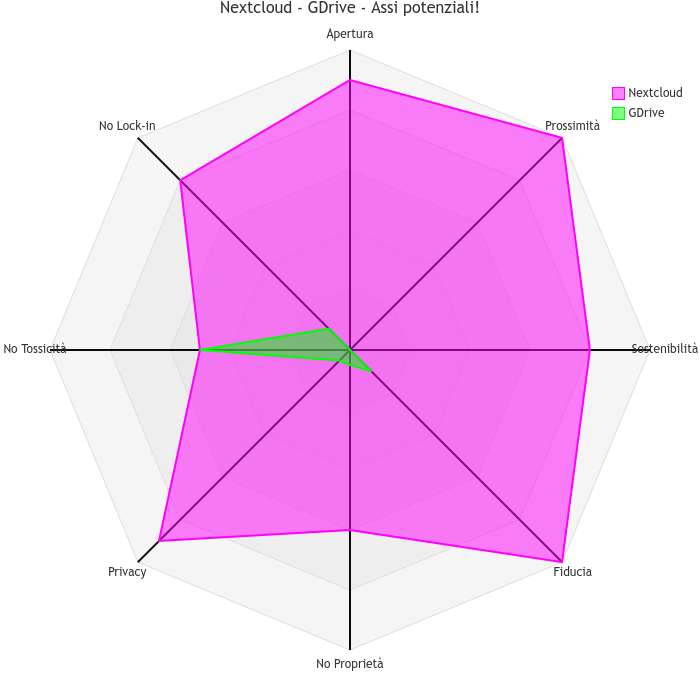
We have developed a system to evaluate technologies, especially digital ones. "Good" and "bad", "just" or "wrong", "nice" or "ugly" are really not enough, in addition to being judgements often due to our personal idiosyncrasies. There are so many aspects to evaluate, every situation is different. We resumed the food allegory and translated it into digital technologies. What are the "nutrients" of technologies? How do they make us better people? Stronger? More autonomous? More collaborative? Less selfish? We have identified eight assessment axes, five positives and three negatives:
- Opening
- Nearness
- Sustainability
- Trust
- Privacy
- No toxicity
- No lock-in
- No property
In a digital system we like it to be open, close to us, sustainable, trusted, reserved (privacy); that it is not toxic, that there are no lock-in closures and that it is a collective good.
This is ideal. In practice, each of these axes intersects with others, in a varied way. Each axis is graduated, from a maximum of one hundred (total opening) to a minimum of zero (no opening). Evaluations are also based on personal, collective and arbitrary qualitative sensations and perceptions: therefore a hypothetical score made by a system could not only vary over time, but also according to those who realize it.
Are there any other axes to be evaluated? For example, how playful is a system? How simple is that? (What does that mean, simple? )
We have experimented on several occasions this method to evaluate technologies. By combining points on the axes you get an area: the more the area is wide, the more the technology we value.
Thanks to the so-called "radar" display, you can compare the areas of different technologies at the same time. In the example below: Nextcloud and GDrive. Evaluation of C.I.R.C.E., 31 May 2026.
To reproduce the task you need:
- a poster/sheet with pens/pennarelli
If you want to do it digital, you can use mermaid, a very simple code. There are also online live editors. We imported the code into Drawio on Nextcloud to be able to play further.
Tips to improve this ethical-technical audit? Write us info AT circex DOT org